
Croft vs Croft
'00s vs '10s. Jolie vs Vikander. Who will win the Croft-off?

Sigourney Weaver, Jason Isaacs, Celia Imrie, and more were announced to join the cast of Amazon MGM’s Tomb Raider earlier this week. Along with Sophie Turner, who takes on the lead role of Lara Croft, the cast will be part of Phoebe Waller-Bridge’s take on the video game, as she creates, writes and executive produces.
It’s not the first action franchise to be Phoebe Waller-Bridgeified, after she starred in the Indiana Jones and the Dial of Destiny (2023) and was co-screenwriter on the latest Bond, No Time to Die (2021). With many itching to see Waller-Bridge’s next big project, they’ll also be eyes on whether Amazon can deliver on another video game adaptation akin to Fallout and whether it can successfully launch a broader Tomb Raider universe.
Although reboots aren’t always deemed for failure, this will be the third iteration of Croft on screen in 25 years. For those at MGM, it’ll be the second attempt at Tomb Raider in a decade. Questions linger as to whether they can stick the landing this time. Comparison will be natural with so much of the same IP in people’s short memories.
As an avid viewer of Lara Croft, with both films in my rotation of action movie rewatches, I’ll be interested to see how the series stacks up and whether having more time to breathe and develop a story as a TV show adds anything.
The cast announcement spurred me to have a sit down with all the current films and compare them with each other, Croft vs Croft.
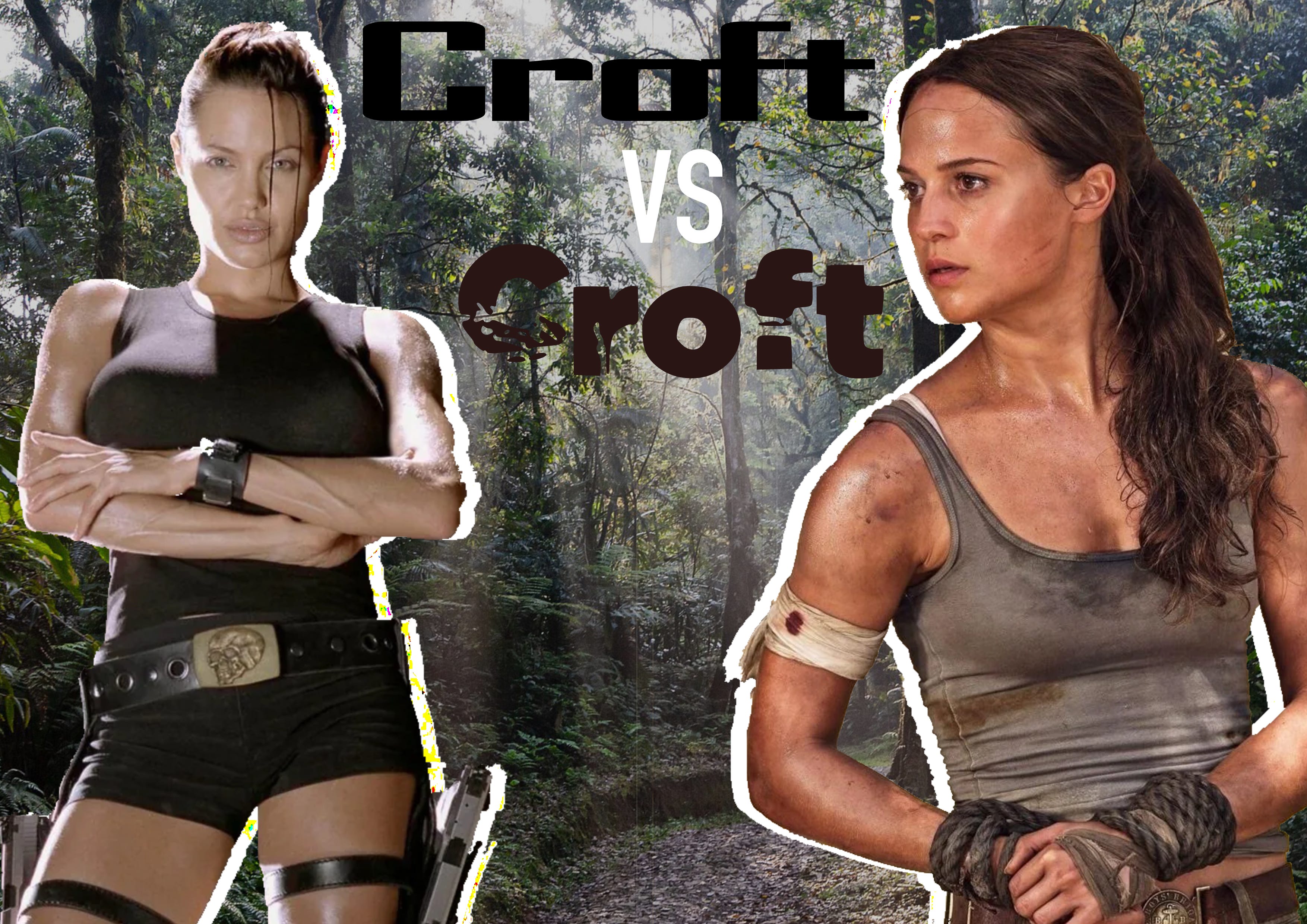
Starting with plot - none of the films follow the exact story of any of the video games, using them more as a springboard. But the 2018 iteration does draw stronger inspiration from the 2013 game storyline. Neither have a particularly high-brow or robust script, with a variety of plot holes and curious decisions made.
Lara Croft: Tomb Raider (2001) sees the heiress-turned-archaeologist-adventurer sent on a mission by a combination of a letter from her dead father and the alignment of the solar systems planets. Croft (Angelina Jolie) is working against the Illuminati to find an artefact that gives you the power to control time and destroy it. In the sequel, Lara Croft: Tomb Raider – The Cradle of Life (2003), Croft is asked by MI6 to retrieve an artefact to prevent a deadly weapon being captured and controlled by a Nobel-Prize-winner-turned-bioterrorist. They let her recruit the help of a state traitor Terry Sheridan (Gerard Butler); the map’s clues are revealed by playing an unspecified sound that makes a golden orb project vague images of the cradle’s location.
In the 2018 film, Lara Croft (Alicia Vikander) finally reconciles herself to declaring her missing father dead to inherit her family wealth. Discovering his secret obsession in archaeology Lara starts following his last quest of finding the tomb of queen Himiko. Led to an island where villain Mathias Vogul (Walton Goggins) has been searching for the crypt for seven years, Croft discovers her father (Dominic West) is still alive. After solving puzzles in the tomb, it’s revealed Himiko was imprisoned due to carrying a deadly disease. Lara prevents Vogul and the virus from escaping but her father dies.
Both films were hardly going to win any awards for best screenplay; however, I think the earlier films are notably better. By leaning into the absurd and extreme – the Illuminati, the reliance on the universe aligning, walking on walls and ceilings, making herself bleed so she could punch a shark on the nose and get it to pull her to the ocean surface – there’s a clear message you need to suspend your disbelief. I don’t think the films were intentionally meant to be this silly, with first director Simon West aiming more for new age futurism and fantasy. Yet it works so incredibly well as a nod to the original form with things only possible outside the real world. It also means lacking internal logic or scientific impossibilities are more excusable.
Meanwhile, the realist take in 2018 makes plot issues clear and the adaption from video game to film is poor. In gameplay, Croft is an archaeology student, positioning her in the world of ancient history and her adventuring coming later. Despite knowing this is an origin narrative, the film sets up a confusing backstory. So much time is spent establishing Lara as physically fit and smart, but she knows little about history and does not seem remotely interested in it. There’s no seeing her grow into a leader or learning, yet she’s constantly thrust into the position of being in charge in the tomb. Her motivations to start raiding tombs, to set up a sequel that never came, are thin and illogical; they are based on bringing down a shady organisation who may have no interest beyond one artefact.
This opposition of a campy, extreme adaptation versus a serious, narrative one also plays heavily into the style of the movies. It’s again a win for the earlier adaptation. Clunky but clear plot development scenes, set piece fights, and puzzles to be solved to gain more knowledge again are all homage to the game format. I loved the fun zoom in shots to Croft’s eyes in The Cradle of Life before fight scenes to feel like a role player game. The ensemble cast of a butler, a tech whizz, an archaeological adversary, a state traitor, ominous organisations, and British aristocratic villains feel like NPC caricatures, there to assist or assail our adventurer.
Meanwhile, Croft in 2018 feels like a lone wolf. Bar ship captain Lu Ren, and later on her father, there isn’t anyone helping Lara. It’s a baffling choice considering she has no idea what she’s doing. The gap between the first puzzle in London and the second on Yakatai island is long and slows the pace; it doesn’t feel like you’re in a video game until over an hour in when you get an overhead running sequence like you’re playing Temple Run.
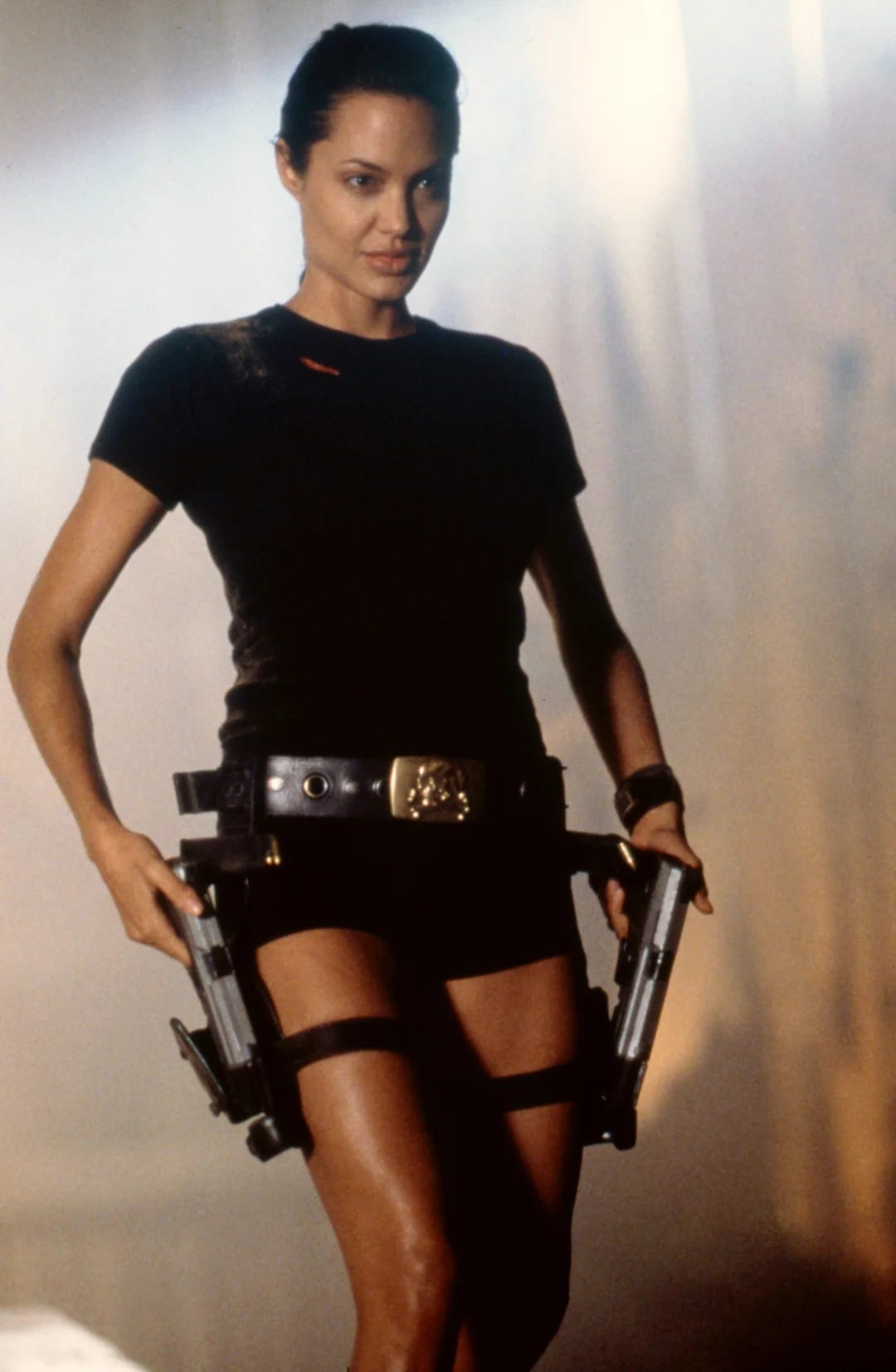
Zooming into our lead, there’s quite a clear difference in the approach to Lara. Early 00’s brand of misogyny means that while adept and capable, Jolie’s Croft is also a sex object. Unnecessarily triangular boobs in the video game become a nude body shot and scene in a towel. There is intense detail paid to her fashion - because of course she thinks about her wardrobe for taking down bad guys! – and she is given love interests.
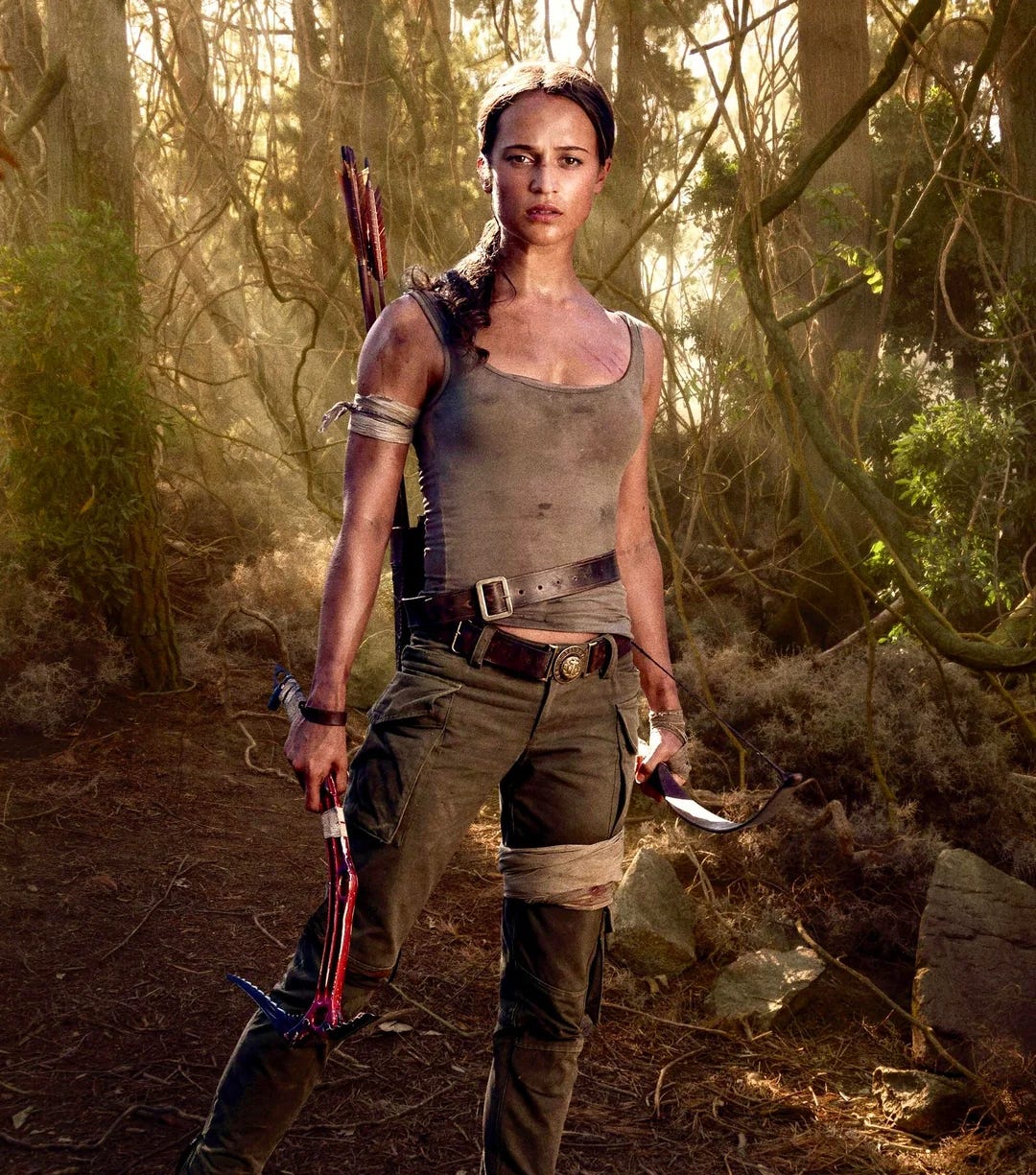
Vikander’s Croft isn’t sexualised at all, but she’s still reduced to her body just in a different way. As always, the misogyny creeps in. From the era of the earnest ‘girlboss’, where women reach the top by being like men and flaunt ‘I’m not like other girls’ credentials, it feels like a lot of time is spent trying not to fall into any type of sexualisation. But, it still loops back around into being sexist. She is portrayed as edgy, physically strong but does little to develop her beyond that. More time is spent on ‘wow look what this woman can do’ compared to solving puzzles or deploying knowledge.
Jolie’s Croft is adept at her job, respected in her field and by her adversaries, but unfortunately viewed as an object. Vikander’s Croft is undeveloped but not designed to be eye candy for gamer bros. I’m unable to decide which is worse, but I think both actresses handle the material they’re given well and try to give the character some dimension.
One thing I will praise in the later movies for is Alicia Vikander clearly doing a lot of work to be able to do her stunts. From the very large number of cuts in Jolie’s films during action sequences, I suspect not all of the action scenes were done by her despite taking on a lot of challenges. It could also have been better editing and visual effects in 2018 to smooth out transitions, and that Jolie’s films had some truly crazy stunts like a 360 flip on a jet-ski, jumping from buildings in paragliding suits, and parachuting in onto the back of a car. But Vikander runs like a video game character with near perfect form, a hard feat to achieve.
Yet for me it’s a clear win for the early 00’s Tomb Raider. It’s stylish, brash, and trusting enough of itself enough to veer from the original material but still conscious of evoking the form. It’s no wonder both films were some of the highest-grossing video game to film adaptions for the time.
It’s the bar Waller-Bridge will need to beat with her version of Tomb Raider. It’ll be interesting to see where she decides to begin, whether she tried to build a better backstory or jumps right into the action. What sort of tone will she take? Can she utilise this ensemble better? Can Turner give Croft depth and nuance to a female character whose so far been sexualised or half-baked?
All I know is it’ll be hard to knock ‘00s Tomb Raider out my bi-annual action film rotation.
Excellent use of canva + critical thought x
the line about alicia running like a video game character is so hilarious lmaooooooooo. this ate as usual diva